AI Search for Small Businesses: What UK Owners Need to Know
If you run a small business in the UK, you have probably heard that AI is changing everything. You have probably also ignored most of it - because you have a business to run and half of what gets written about AI has nothing to do with you.
Fair enough. But this bit does.
A growing number of your customers are now using AI tools like ChatGPT, Gemini, and Perplexity to find businesses like yours. Not in some theoretical future - right now, today. And the way these tools find and recommend businesses is completely different from Google.
This is not a technology article. There is no jargon. This is a plain English explanation of what AI search means for your small business, why you should care, and what you can actually do about it.
What is AI search?
You already know how Google works. Someone types "plumber in Leeds" and gets a list of results. They scroll, they compare, they pick someone.
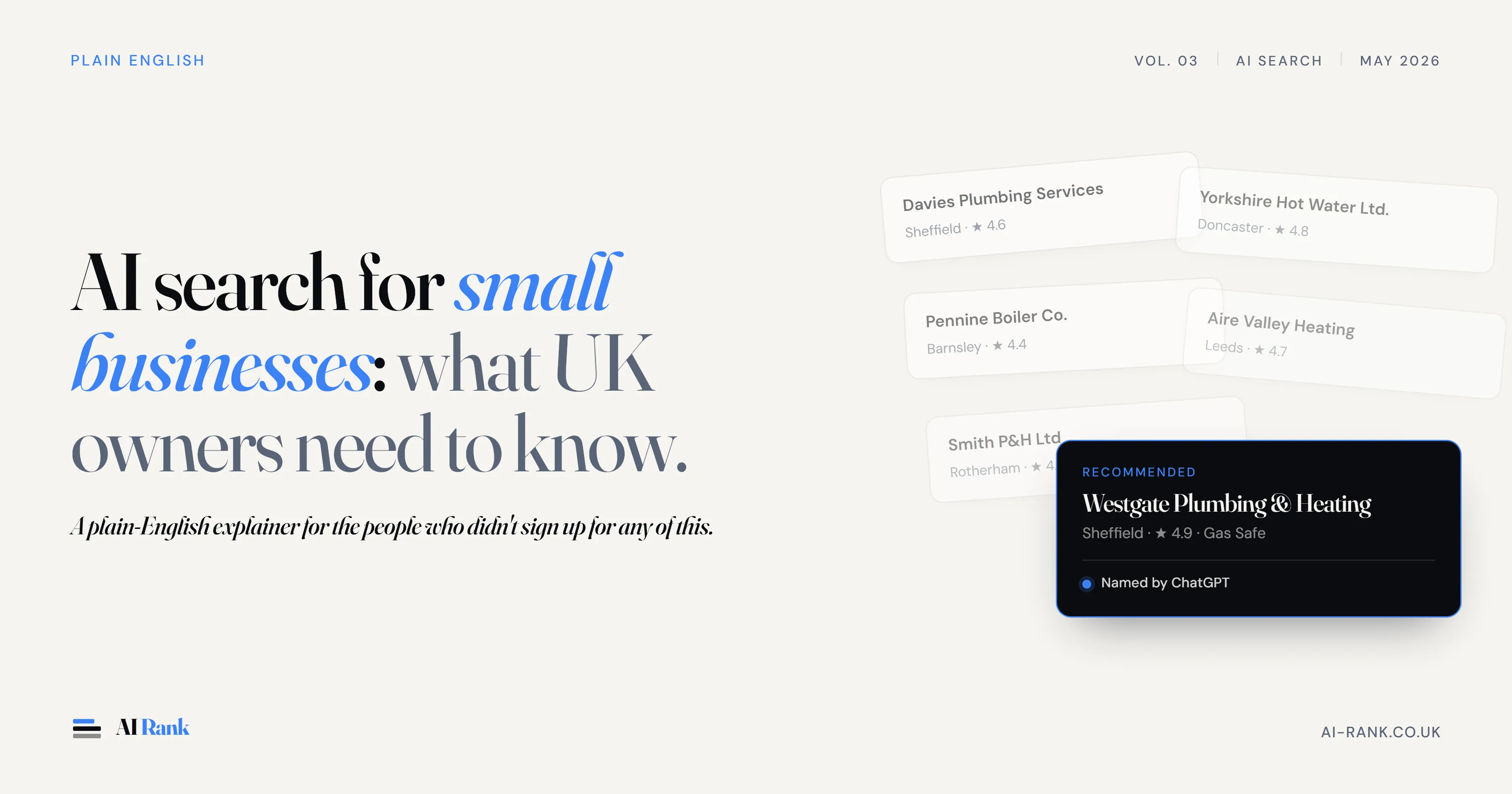
AI search is different. Instead of typing keywords, your customer asks a question in natural language: "My boiler has broken down and I need someone in Sheffield today - who should I call?" The AI gives them a direct answer - a handful of businesses it recommends, with reasons for each one.
It might show a map. It might show ratings. But the key difference is that the AI has already done the comparison your customer used to do themselves. It has filtered through everything it knows about local businesses and picked the ones it is confident enough to name.
Your customer did not open five websites. They did not read twenty reviews. They asked one question and got a shortlist they trust. If your business was not on it, they will never know you exist.
How many people in the UK are actually using this?
More than you would think.
According to IAB UK and UKOM, 22.5 million people in the UK were using AI tools by October 2025, with 1.46 million new users joining in just that month. ChatGPT captured 84% of all time spent on AI tools. And this is not just young people - growth in AI tool usage among 35 to 54 year olds jumped 49% in six months.
Mintel's 2026 UK Consumers and AI report found that 56% of UK AI users now use AI search daily.
The British Chambers of Commerce reported that 54% of UK small and medium-sized businesses are now actively using AI in some form - up from 35% in 2025 and 25% in 2024. Your customers are using AI to find businesses. Your competitors are using AI to run theirs. This is not niche technology any more.
Why should a small business care?
Because AI search works differently from Google - and the difference is not in your favour.
When a customer searches Google, they get a long list of options. Even if you are not at the very top, you are visible. They might scroll down, see your name, click through, and choose you. Google gives every business on the first page or two a fighting chance.
AI does not work that way. When a customer asks ChatGPT for a recommendation, the AI picks a small number of businesses to name. Everyone else is invisible. There is no second page. There is no scrolling. If you are not recommended, you are not part of the conversation.
And here is the uncomfortable reality: SOCi's 2026 Local Visibility Index found that only 1.2% of local businesses are recommended by ChatGPT. That is 12 in every 1,000. The other 988 do not get mentioned - no matter how good they are, as we covered in our first article.
Does Google ranking help?
Less than you would hope.
The same SOCi research found that only 45% of businesses ranking well on Google also appear in AI recommendations. More than half the businesses winning on Google are invisible to AI.
That is because Google and AI use different signals. Google ranks web pages based on keywords, backlinks, and page speed. AI recommends businesses based on something else entirely: whether it can find clear, consistent, verifiable information about your business from multiple independent sources.
Your website might rank first on Google. But if your business name is slightly different on your Google listing, your Facebook page, and your Trustpilot profile, the AI sees contradictions. If your website says you are a plumber but does not clearly state which areas you cover, the AI does not have enough to work with. If your reviews only exist on Google and nowhere else, the AI has fewer sources to cross-reference.
Google cares about your website. AI cares about your entire online presence - and whether it all tells the same story, as explained in our second article.
What about zero-click searches?
This is another shift happening at the same time, and it makes the AI visibility problem worse.
Nearly 60% of Google searches now end without the user clicking through to any website at all. Google's own AI Overviews, featured snippets, and local packs are answering questions directly on the results page.
For local searches on mobile, the figure is even higher - up to 78% according to Similarweb. That means for most local searches, even if you rank on Google, the customer may never visit your website. They get the information they need from the search results page itself.
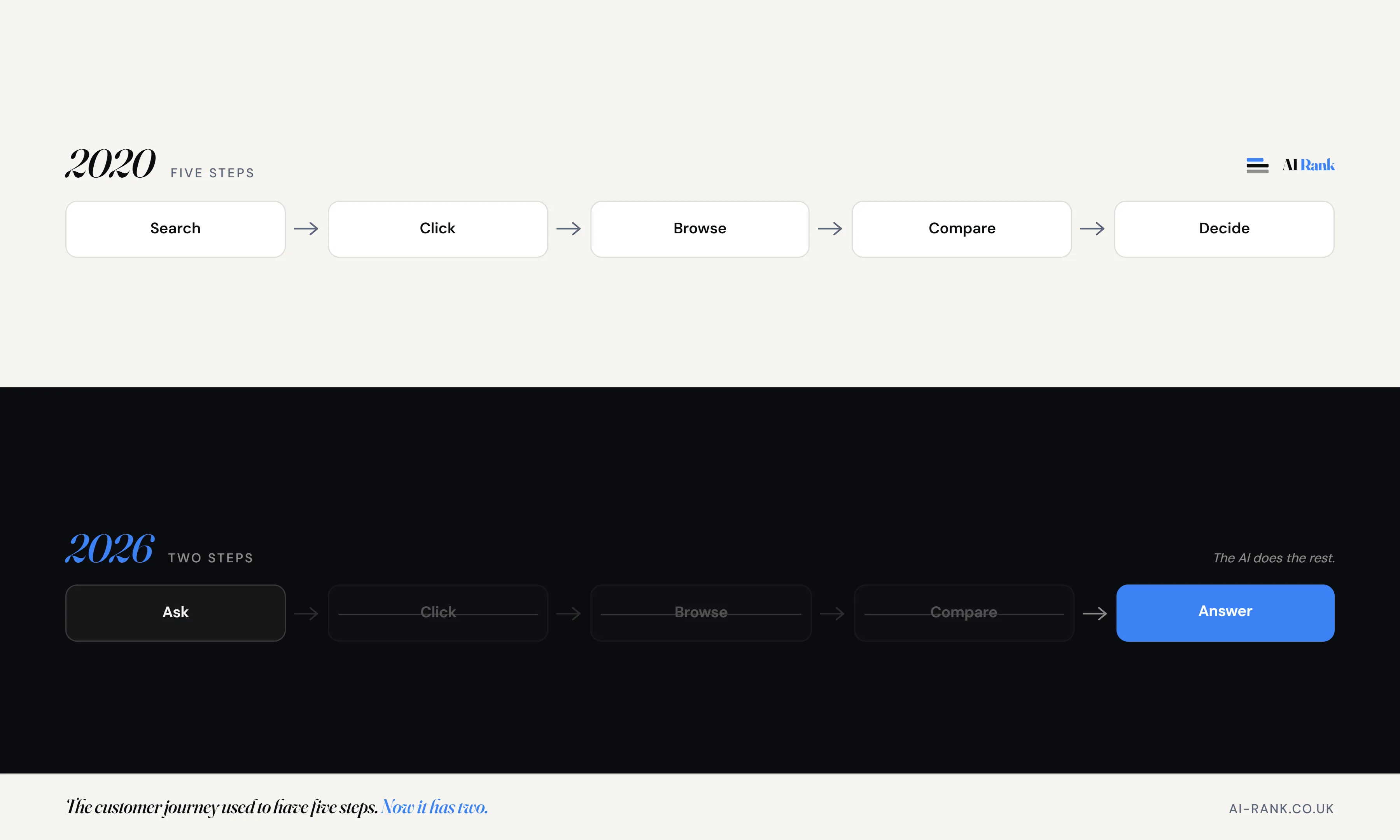
This is happening on Google, and it is happening even more aggressively on AI platforms where there are no organic links to click at all. The customer asks, the AI answers, the customer acts. Your website was never part of the journey.
Gartner predicted that organic search traffic would decline 25% by 2026 due to AI chatbots. Current data suggests that estimate was conservative.
What can a small business actually do?
There are some practical things you can start with today. None of them require technical expertise - just time and attention.
Make your website say what you actually do. This is the single most common problem. If your homepage says "Welcome to Smith and Sons - quality you can trust since 1987," the AI learns nothing useful about you. If it says "Emergency plumber covering Sheffield, Rotherham, and Doncaster - combi boiler repairs, central heating installation, and 24-hour callouts," the AI knows exactly what you do and where. Be specific. Be clear. Write it the way you would describe your business to a stranger at a networking event.
Use the same name everywhere. If your website says "Smith Plumbing," your Google listing says "Smith Plumbing and Heating Ltd," and your Facebook says "Smiths Plumbing Services" - the AI might think these are three different businesses. Pick one name and use it consistently across your website, Google Business Profile, social media, and every directory you are listed on.
Get reviews on more than one platform. Google reviews are important, but AI also checks Trustpilot, Checkatrade, TripAdvisor, Yelp, and industry-specific directories. The more places that independently confirm you are good at what you do, the more confident the AI is in recommending you. You do not need hundreds of reviews everywhere - even a handful on two or three platforms makes a difference.
Get listed on trusted directories in your industry. AI keeps mentioning directory presence when recommending local businesses. Checkatrade, Bark, Yell, TripAdvisor, industry-specific directories - these are the places AI cross-references when deciding who to recommend. You do not need to be on every directory, but being on two or three trusted ones in your trade makes a real difference. If your competitors are listed and you are not, that is a gap AI can see.
Make sure AI can actually read your website. This is a quick technical check. Your website has a file called robots.txt that tells bots which parts of your site they can read. Some websites are set up to block AI crawlers without the owner knowing. If you are not sure, ask whoever built your website to check. While you are at it, adding structured data (machine-readable labels for your business name, address, phone number, and services) can help, though our testing shows AI rarely cites it as a primary reason for recommending a business. Think of it as good housekeeping rather than a game-changer.
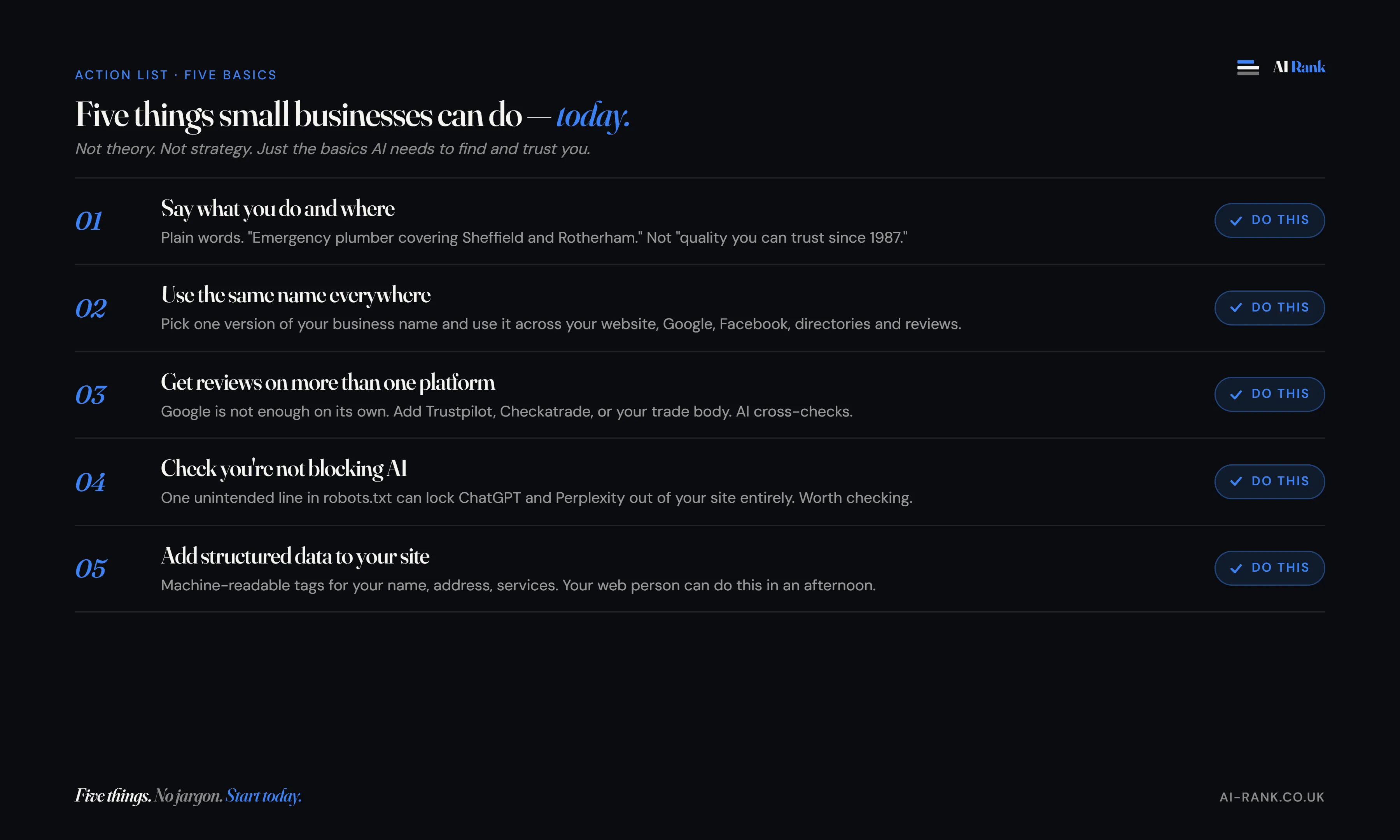
These five things will not guarantee AI recommends you overnight. But based on what we see AI repeatedly mentioning when it recommends local businesses, they close the most common gaps and give you a stronger foundation than the vast majority of your competitors.
How to know where you actually stand
The steps above will help. But the honest truth is that doing this properly means understanding exactly where you stand across every major AI platform right now - not guessing, not assuming.
Which AI platforms mention your business? Which ones recommend your competitors instead? What does the AI say about them that it does not say about you? Where are the specific gaps in your online presence that are keeping you invisible?
That is what we built AI Rank to do.
You can start with a free check right now - just your business name and your town. We run it through ChatGPT, Gemini, Perplexity, Claude, and DeepSeek and show you what comes back. It takes thirty seconds and gives you an immediate snapshot of your AI visibility.
Is AI recommending your business?
Find out in 30 seconds. See who AI recommends instead of you.
Check my AI visibilityIf you want the full picture - detailed audit reports across every AI platform, an action plan showing exactly what to fix and in what order, and ongoing monitoring so you can track your progress month by month - that is what our paid plans are for. But the free check is the best place to start.
This is not going away
AI search is growing faster than any other channel in how people find local businesses. The UK already has 22.5 million AI tool users. That number is going up, not down.
The small businesses that start paying attention now will have a significant head start. AI recommendations compound over time - the longer you are recommended, the more confident the AI becomes in recommending you again.
The ones that wait will find their competitors have been building AI presence while theirs was invisible.
You do not need to become an AI expert. You do not need to overhaul everything overnight. Start with the five basics above, run the free check, and see where you stand.
Check if AI recommends your business
Run a free check to see whether AI can find your business, who it recommends instead, and what to improve first.
Check if AI recommends your businessSources
IAB UK / UKOM Ipsos iris, October 2025 - 22.5 million UK AI tool users; 84% of time spent on ChatGPT; 35-54 age group usage grew 49% in six months; 1.46 million new users in one month
Mintel, UK Consumers and AI 2026 - 56% of UK AI users use AI search daily
British Chambers of Commerce, March 2026 - 54% of UK SMEs actively using AI, up from 35% in 2025 and 25% in 2024
SOCi, 2026 Local Visibility Index (350,000+ locations, 2,751 brands) - 1.2% of locations recommended by ChatGPT; 45% overlap with Google rankings
Similarweb, 2025 - local-intent mobile searches produce up to 78% zero-click outcomes
SparkToro / Datos, 2025 - nearly 60% of Google searches end without a click
Gartner, 2024 projection - organic search traffic to decline 25% by 2026 due to AI chatbots