Your Business Might Exist Online - But AI Still Can't See It
Something strange is happening in local search. You have done everything right.
You have a website. A Google Business Profile. A Facebook page. Maybe an Instagram account. You have collected reviews, kept your hours up to date, and you even paid someone to do your SEO a couple of years ago.
So when a potential customer asks ChatGPT "who is the best plumber in Sheffield?" or tells Perplexity "recommend a solicitor in Manchester" - you should show up. Right?
Probably not.
Because having an online presence and being visible to AI are two completely different things. And right now, the gap between them is catching thousands of UK businesses off guard.
Being online is not the same as being AI-visible
This is the part that frustrates most business owners when they first hear it. You have spent years building your online presence. You have invested real money. And now someone is telling you that none of it counts?
Not exactly. Everything you have built still matters for Google. Your website still ranks. Your reviews still help. Your Google Business Profile still drives calls from Google Maps.
But AI search works differently. When someone asks ChatGPT for a recommendation, it does not open Google and pick the top result. It draws on its own understanding of businesses - built from information scattered across the entire web - and decides which ones it is confident enough to name.
That confidence comes from a different set of signals than the ones Google uses. And most businesses, even ones with strong Google rankings, are sending confusing or incomplete signals to AI platforms.
How do we know? Because SOCi's 2026 Local Visibility Index analysed over 350,000 business locations and found that only 45% of businesses performing well on Google also appeared in AI recommendations. More than half the businesses winning on Google are invisible to AI. Being online and being AI-visible are clearly not the same thing.
What AI actually needs to understand about your business
When a customer asks Google a question, Google matches keywords on your website to keywords in the search query. It is pattern matching. If the right words are on your page, you have a chance of showing up.
AI does not work that way. AI tries to understand your business as a real-world entity - not just a collection of web pages. It wants to know:
Who are you? Not your domain name. Your actual business name, who runs it, how long you have been operating, and what you are qualified to do.
What exactly do you do? Not "we provide quality services." AI needs specifics. Do you repair combi boilers? Do you handle residential conveyancing? Do you serve Sunday lunch? Vague service descriptions are invisible to AI.
Where do you operate? AI needs to know your service area, not just your registered address. A plumber based in Leeds who also covers Wakefield, Harrogate, and Bradford needs that information to be clear and consistent - everywhere.
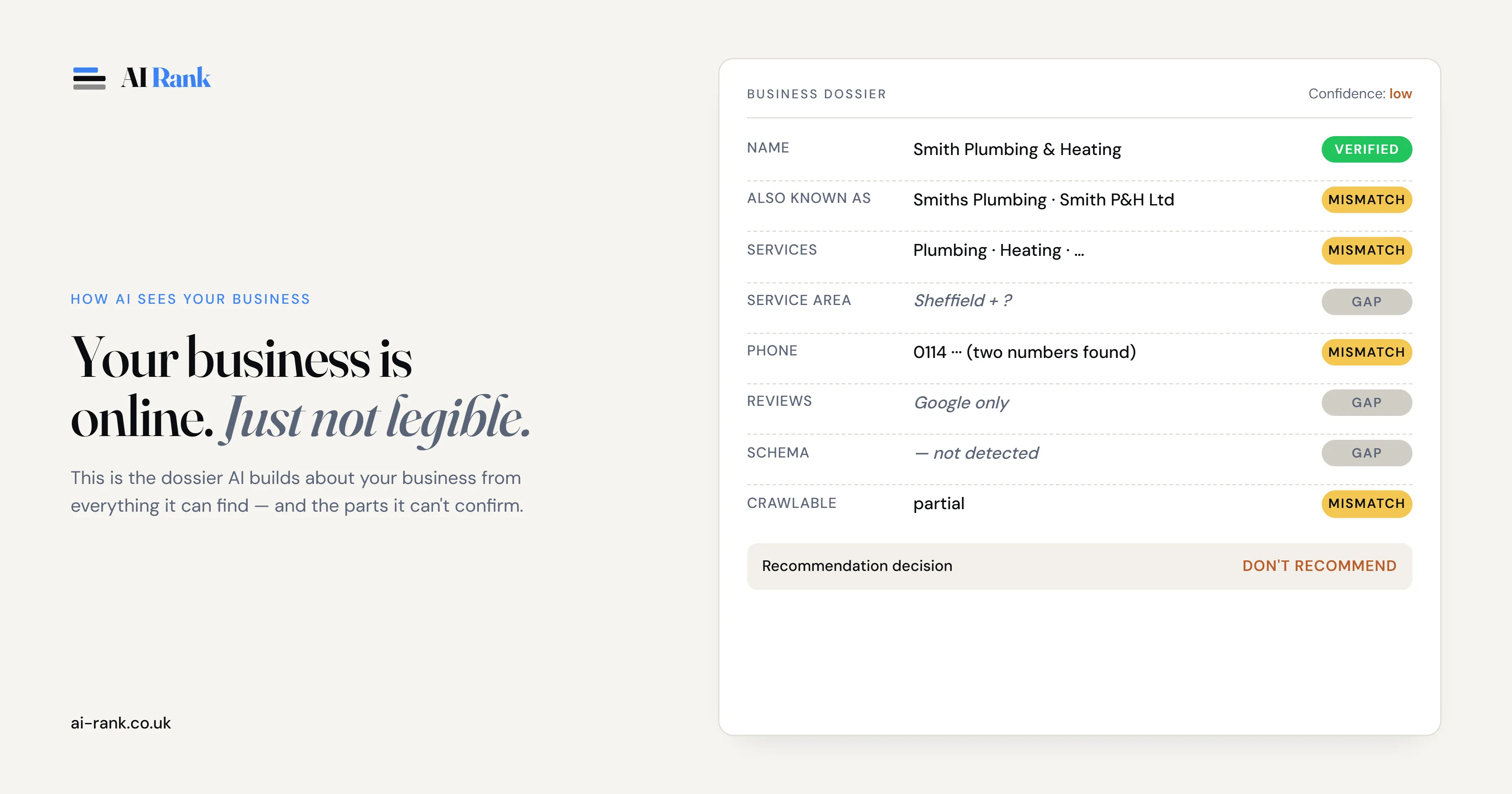
Can it verify what you claim? This is the one that catches most businesses out. AI cross-references your information across multiple sources. If your website says one thing, your Google listing says another, and your Yell profile has an old phone number, the AI sees contradictions. And an AI that sees contradictions does not recommend you. It recommends someone it can verify.
The five things that make your business invisible to AI
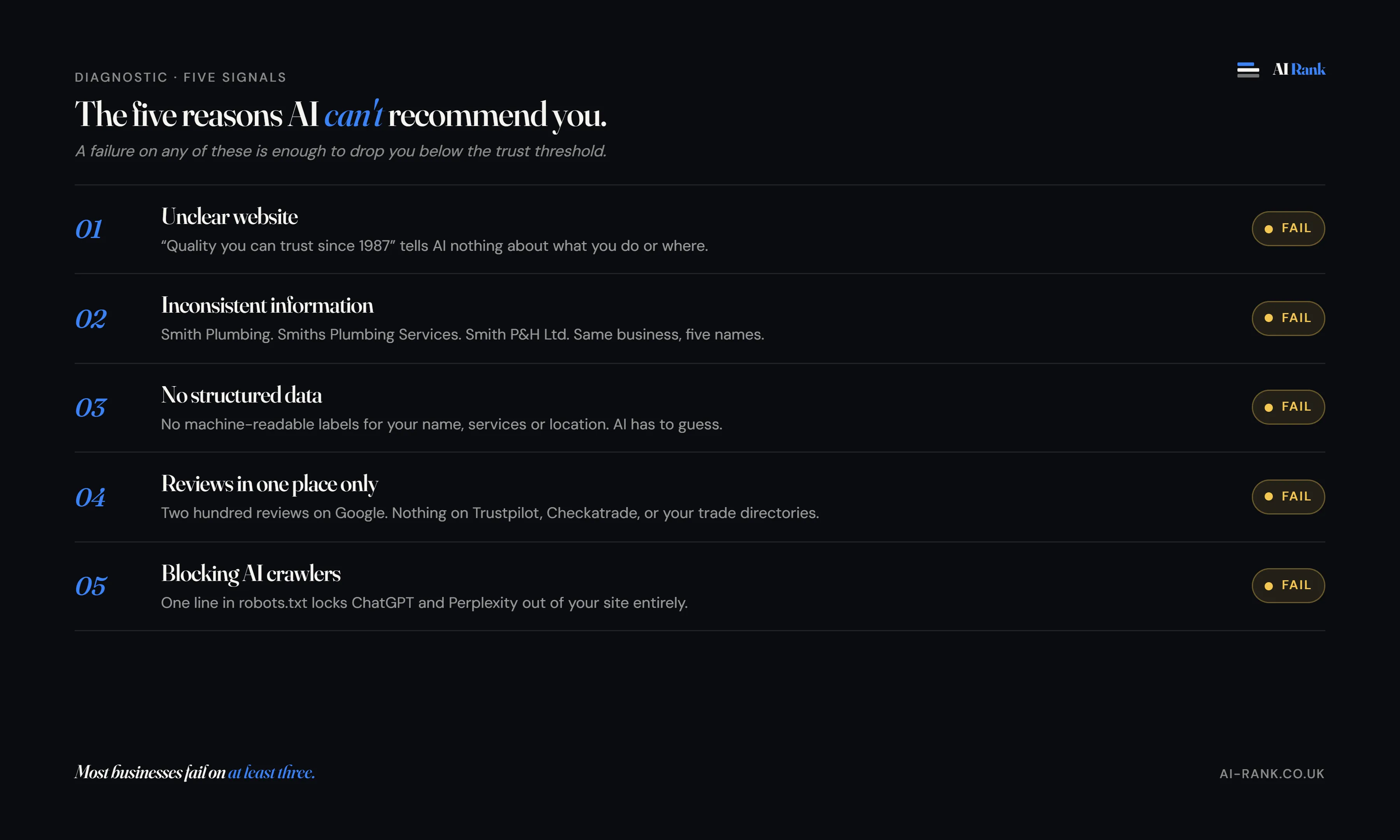
Through our own work auditing businesses across the UK, the same problems come up again and again. These are not obscure technical issues. They are simple things that most business owners do not know to check.
Your website does not clearly state what you do and where you do it. This sounds basic, but it is astonishingly common. Think about your own homepage. Does it say "Welcome to Smith and Sons - quality you can trust since 1987"? Or does it say "Emergency plumber covering Sheffield, Rotherham, and Doncaster - combi boiler repairs, central heating installation, and 24-hour callouts"? The first tells AI nothing. The second tells it everything.
Your information is different across different platforms. Your website says "Smith Plumbing." Your Google listing says "Smith Plumbing and Heating Ltd." Your Facebook page says "Smiths Plumbing Services." To a human, these are obviously the same business. To AI, they might not be. Consistency matters enormously because AI uses it as a trust signal. If it cannot confidently match your business across different sources, it will not risk recommending you.
You are not listed on the directories AI checks. AI does not just look at your website. It cross-references information from directories, review platforms, and trusted third-party sources. If your competitors are listed on Checkatrade, Bark, Yell, or industry-specific directories and you are not, AI has more sources confirming their credibility than yours. Our own testing shows that directory presence is one of the most commonly cited factors when AI explains why it recommended a business. You do not need to be on every directory - but being absent from the ones that matter in your trade is a gap AI can see.
Your reviews only exist in one place. You might have 200 five-star reviews on Google. That is great for Google. But AI also checks Trustpilot, Checkatrade, TripAdvisor, Yelp, and industry-specific directories depending on your trade. If your reviews only exist on one platform, AI has fewer sources to cross-reference and less confidence in recommending you.
Your website is technically invisible to machines. Your website might look great to human visitors but still be hard for AI to read. Two quick checks: first, your robots.txt file might be blocking AI crawlers without you knowing - ask whoever built your website to check. Second, adding structured data (machine-readable labels for your business name, services, and contact details) can help AI understand your site more clearly. Our testing shows that AI rarely cites structured data as a primary reason for recommending a business, but it is still good practice - think of it as making your website easier for machines to read, not as the thing that will get you recommended.
The trust gap
Here is the core concept to understand: AI recommendations are built on trust, not rankings.
Google shows you a list and lets you decide. AI picks one business and vouches for it. That means AI is putting its own reputation on the line every time it makes a recommendation. If it sends someone to a plumber who does not exist, or a restaurant that closed six months ago, or a solicitor with the wrong phone number - the user loses trust in the AI.
So AI is cautious. It recommends businesses it can verify from multiple independent sources. Businesses where the name, address, phone number, services, and reviews all tell a consistent, clear, confirmable story.
If your online presence has gaps, contradictions, or missing information - even small ones - you fall below the AI's confidence threshold. And below that threshold means invisible. SOCi's research found that only 1.2% of local businesses clear that bar with ChatGPT, as we covered in our previous article. That means 98.8% are invisible - not because they are bad businesses, but because the AI is not confident enough to name them.
Is your business legible to AI?
Find out in 30 seconds. See what AI actually sees about you.
Check my AI visibilityWhy this matters now
You might be thinking: this is a future problem. I will deal with it when AI search gets bigger.
It is already bigger than most people realise. According to Mintel, 56% of UK AI users now use AI search daily. Growth in AI tool usage among 35 to 54 year olds - the age group most likely to be hiring tradespeople, booking restaurants, and instructing solicitors - jumped 49% in just six months according to IAB UK.
And here is the compounding problem: AI learns from patterns over time. The businesses that are being recommended now are building a track record of being recommended. The AI sees that people engage with those recommendations, and it becomes more confident recommending them again. The gap between visible and invisible businesses gets wider every month.
Starting six months from now instead of today is not just six months late. It is six months of your competitors building AI presence while yours stays at zero.
What to do first
You do not need to overhaul your entire online presence overnight. But you do need to find out where you stand.
The first step is simple: check whether AI can actually see your business. Not whether your website ranks on Google. Not whether you have reviews. Whether AI - the thing your customers are increasingly using to find businesses like yours - can find you, understand you, and recommend you.
That is what our free AI visibility check does. You type in your business name and your town, and we run it through every major AI platform to see what comes back. It takes thirty seconds. No account needed. No sales pitch.
If AI can see you, great - you are ahead of most of your competitors. If it cannot, you will know exactly where the gaps are.
Either way, you will know. And knowing is the first step to not being invisible.
Check if AI can see your business
Run a free check to see whether AI can find your business, who it recommends instead, and what to improve first.
Check if AI can see your businessSources
SOCi, 2026 Local Visibility Index (350,000+ locations, 2,751 brands) - 1.2% of locations recommended by ChatGPT; 45% overlap between Google rankings and AI recommendations
Mintel, UK Consumers and AI 2026 - 56% of UK AI users use AI search daily
IAB UK / UKOM Ipsos iris, September 2025 - AI tool usage among 35-54s grew 49% in six months