Why ChatGPT Recommends Some Local Businesses and Ignores Others
Something strange is happening in local search.
A plumber in Leeds with hundreds of five-star Google reviews, a beautiful website, and fifteen years of experience is completely invisible to ChatGPT. Meanwhile, a competitor who opened eighteen months ago keeps getting recommended to every person who asks.
A restaurant in Bristol with a packed dining room every weekend does not appear when someone asks Perplexity "where should I eat tonight?" But the place two streets over - the one with fewer reviews and a worse Google rating - gets mentioned by name, with a glowing summary the owner did not write.
This is not a glitch. It is a fundamental shift in how customers find businesses. And most business owners have no idea it is happening.
The way people search has changed
For twenty years, being found online meant one thing: ranking on Google. You would optimise your website, collect reviews, manage your Google Business Profile, and wait for customers to find you in a list of ten blue links.
That era is ending.
Millions of people now skip Google entirely. They open ChatGPT, Gemini, or Perplexity and ask questions the way they would ask a friend:
"My boiler has broken down and I need someone in Sheffield today - who should I call?"
"Recommend a good Italian restaurant in Manchester for a date night."
"I need a solicitor in Birmingham who handles commercial leases. Who is the best?"
The AI does not give them a list of ten links. It gives them a direct answer - a confident recommendation of one, two, or three businesses - with names, reasons, and enough detail to make the call. And every time someone asks the same question, the AI might give a completely different answer.
There is no page two. There is no scrolling down. If your business is not being mentioned, you are invisible to that customer.
How big is this shift?
The numbers are hard to ignore, and the UK is not immune.
According to Mintel's 2026 UK Consumers and AI report, 56% of UK AI users now use AI search daily. Research from IAB UK and UKOM found that while younger audiences led the way, growth in AI tool usage among 35 to 54 year olds jumped 49% in just six months, meaning this is no longer a Gen Z trend. It is mainstream.
Globally, BrightLocal's 2026 Local Consumer Review Survey found that 45% of consumers use AI tools for local business recommendations, up from just 6% the year before. AI is already the third most popular way people discover local businesses, behind only Google and Facebook.
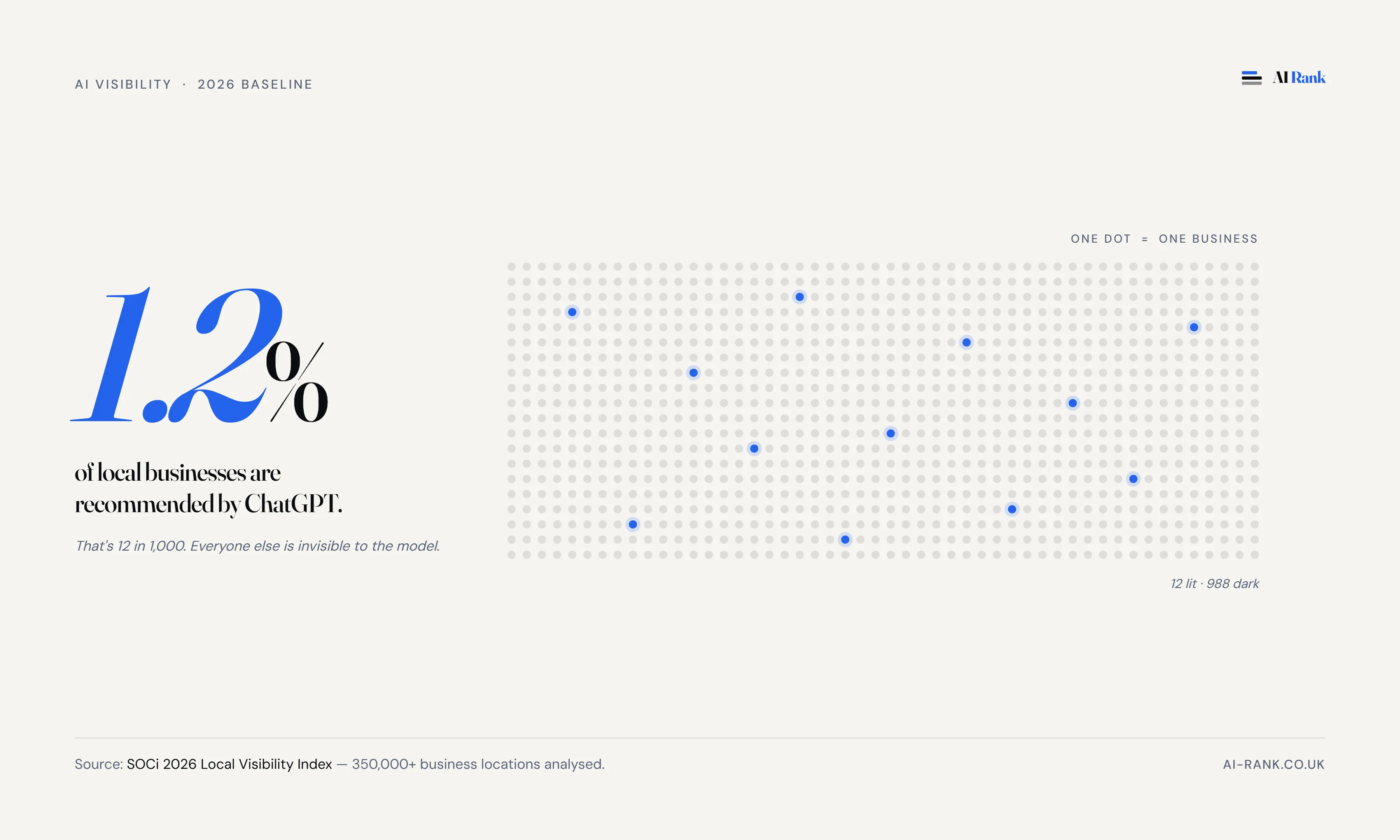
But here is the problem: almost nobody is showing up. Research from SOCi's 2026 Local Visibility Index, which analysed over 350,000 business locations across 2,751 brands, found that only 1.2% of local businesses are recommended by ChatGPT. And the overlap between businesses that rank well on Google and those that appear in AI recommendations is just 45%.
In other words, being great at Google SEO does not mean AI will recommend you. More than half the businesses winning on Google do not show up in AI answers at all.
That is a completely different game. And most businesses have not realised the rules have changed.
So why does AI recommend one business over another?
This is the question every local business owner should be asking. And the answer is more surprising than you might expect.
Google ranks websites. It looks at links, keywords, page speed, mobile-friendliness, and hundreds of other signals to decide which page deserves to appear in search results.
AI does not rank websites. It recommends businesses.
That is a crucial distinction. When someone asks ChatGPT for a plumber, it does not crawl the web in real time and pick the best-optimised page. Instead, it draws on everything it knows about that business from across the entire internet - your website, your reviews, your directory listings, your social media profiles, mentions in local press, professional body memberships, industry directories - and decides whether it trusts you enough to put its reputation on the line by recommending you.
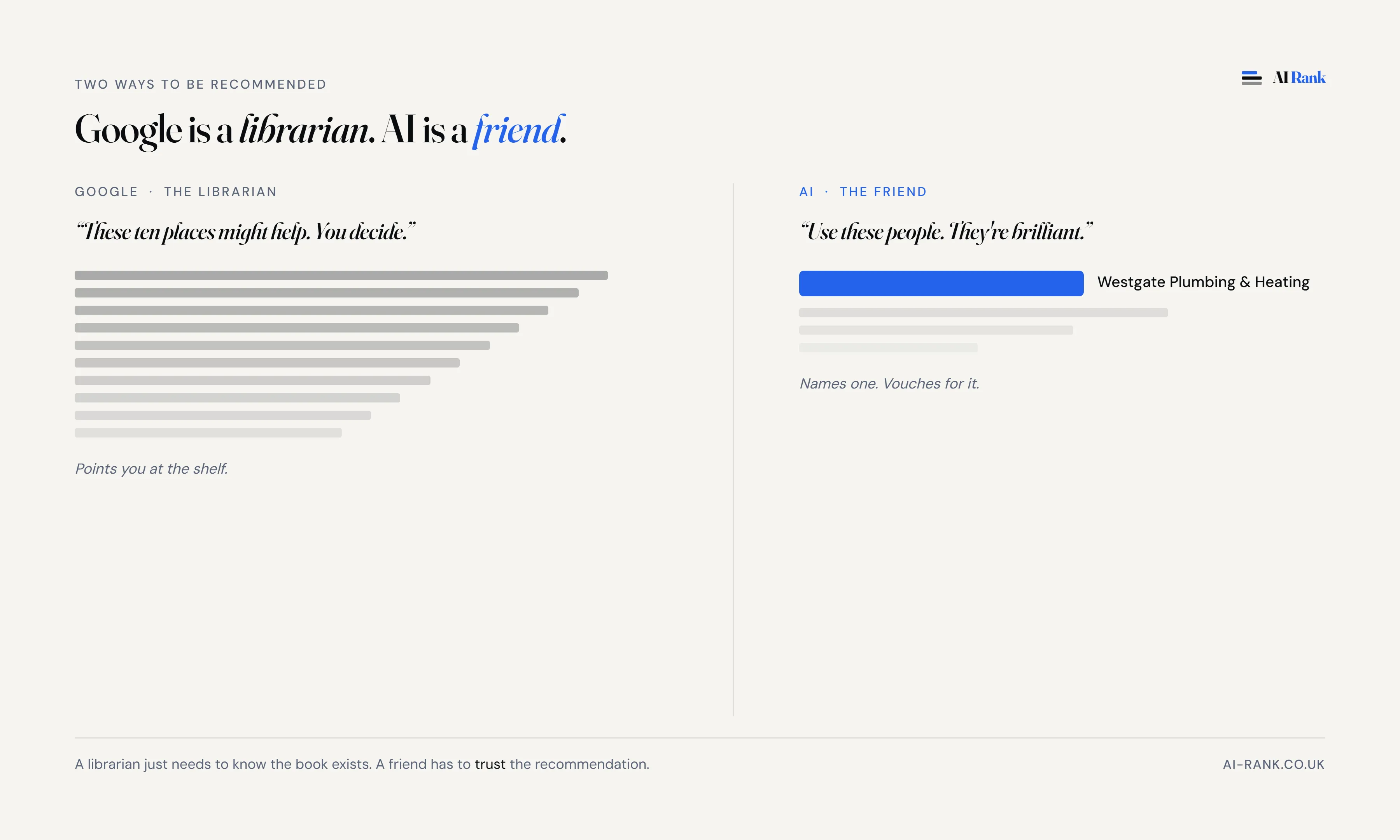
Think of it this way: Google is a librarian pointing you to the right shelf. AI is a friend confidently saying "use these people, they are brilliant." A librarian just needs to know the book exists. A friend needs to actually trust the recommendation.
That is why a business with a perfect Google ranking can be completely invisible to AI. If the AI cannot find enough information about you from enough different, trustworthy sources, it simply will not risk recommending you. It will recommend someone it is more confident about, even if that business is objectively worse.
What AI can see (and what it cannot)
Here is where it gets interesting for business owners.
Your website might be perfectly optimised for Google. But can AI actually understand what you do? If your homepage says "Welcome to Smith and Sons - providing quality service since 1987" but does not clearly state that you are an emergency plumber covering Sheffield and Rotherham who specialises in combi boiler repairs, the AI has nothing useful to work with.
AI needs clear, specific, verifiable information. It is looking for:
- What you do - not vague mission statements, but specific services described in plain language.
- Where you do it - the exact areas you serve, not just your registered address.
- What other people say about you - reviews, ratings, and mentions that it can cross-reference and verify.
- Consistency - the same business name, address, and phone number everywhere you appear online.
If any of these are missing, unclear, or contradictory across different sources, the AI loses confidence. And an AI that is not confident simply picks someone else.
This is why a newer competitor can overtake an established business in AI recommendations. They might have a clearer website, more consistent directory listings, and a stronger presence on the platforms that AI actually checks. None of that has anything to do with how long you have been in business or how many Google reviews you have.
The invisible problem
The most dangerous part of this shift is that you cannot see it happening.
If your Google ranking drops, you notice. Your website traffic falls. Your phone stops ringing. You know something is wrong.
But if AI is recommending your competitor instead of you, there is no dashboard showing you that. There is no notification. Your existing customers still find you through Google, through word of mouth, through the channels that have always worked. Meanwhile, a growing stream of new customers, the ones asking AI for recommendations, are being sent straight to your competition.
You do not see the customers you are losing because they never reach you in the first place. They ask the AI, the AI answers, they call someone else. You never knew they existed.
By the time the effect shows up in your bottom line, your competitor has been building their AI presence for months. And because AI learns from patterns over time, the longer they are recommended and you are not, the harder the gap becomes to close.
Is your business invisible to AI?
Find out in 30 seconds. See who AI recommends instead of you.
Check my AI visibility →What can you do about it?
The first step is finding out where you stand. Not guessing. Not assuming your Google ranking means you are covered. Actually checking whether AI recommends you, who it recommends instead, and what it says about them that it does not say about you.
That is what we built AI Rank to do.
We run your business through every major AI platform - ChatGPT, Gemini, Perplexity, Claude, and DeepSeek - using the kinds of questions your customers actually ask. We show you exactly who gets recommended, what the AI says about them, and where the gaps are in your online presence that are keeping you invisible.
You can start with a free check right now. No account needed. Just your business name and your town. It takes thirty seconds, and you will see immediately whether AI can find you, or whether it is sending your customers somewhere else.
This is not going away
AI search is not a trend. It is not a fad. It is the biggest change in how customers find local businesses since Google itself.
The businesses that figure this out early, the ones who check their AI visibility, understand where the gaps are, and start fixing them now, will have an enormous head start. Because AI models learn and update over weeks and months, not overnight. The sooner you start, the sooner the AI has something to recommend.
The businesses that wait will keep wondering why the phone is not ringing as much as it used to.
Do not be the business that finds out too late.
Check if AI recommends your business
Run a free check to see whether AI can find your business, who it recommends instead, and what to improve first.
Check if AI recommends your businessSources
Mintel, UK Consumers and AI 2026 - 56% of UK AI users use AI search daily
IAB UK / UKOM Ipsos iris, September 2025 - AI tool usage among 35-54s grew 49% in six months
BrightLocal, Local Consumer Review Survey 2026 - 45% of consumers use AI for local recommendations (US panel, 1,002 respondents)
SOCi, 2026 Local Visibility Index (350,000+ locations, 2,751 brands) - 1.2% of locations recommended by ChatGPT; 45% overlap with Google rankings; AI visibility up to 30x harder than Google local pack
Local Falcon, AI Visibility Crisis Study 2026 (189,905 ChatGPT results vs 16.4M Google results) - 83% of restaurants completely invisible on ChatGPT