Why Your Competitors Show Up in AI Search and You Don't
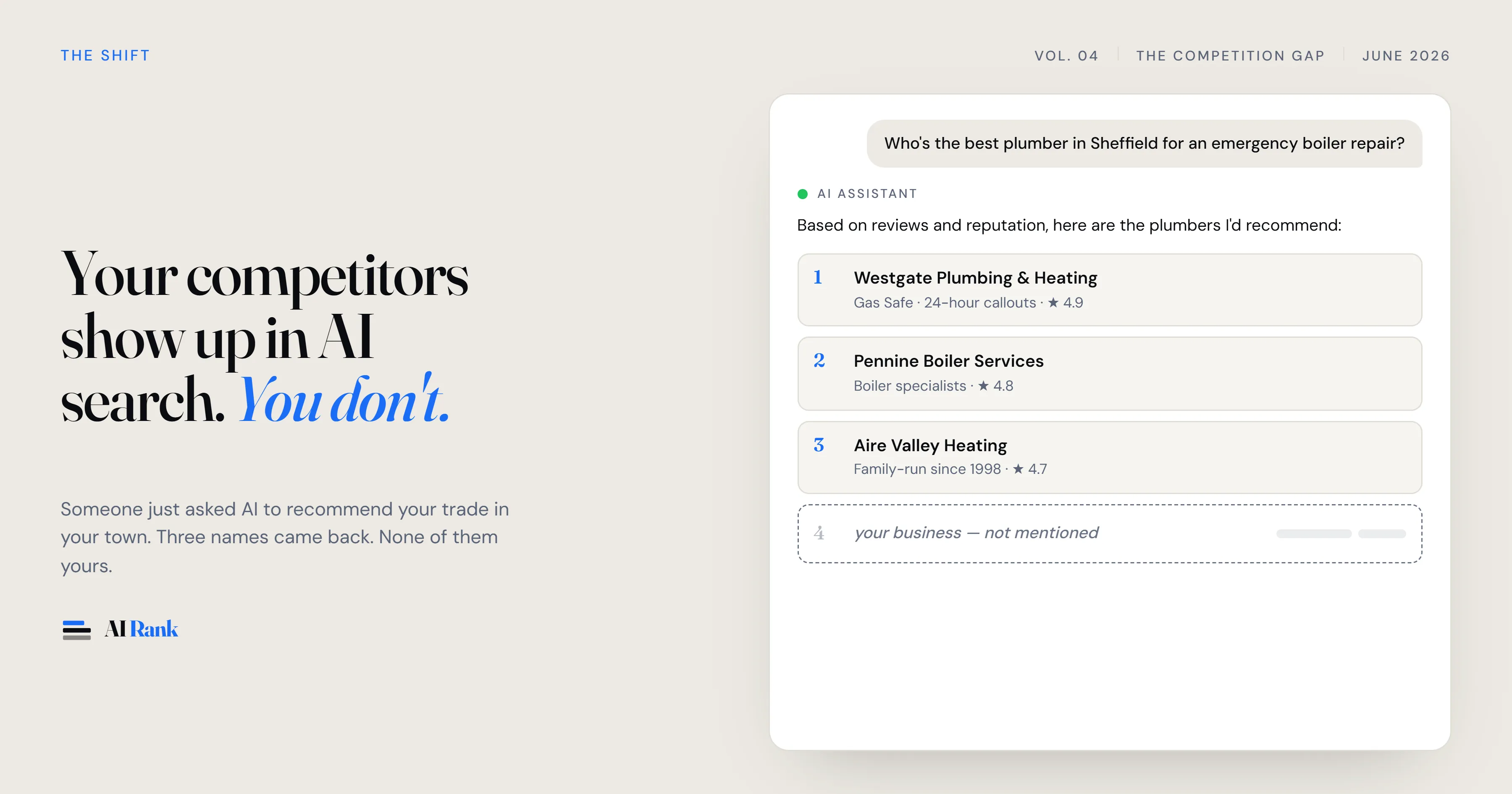
You typed your trade and your town into ChatGPT. Maybe you tried Perplexity. Maybe Gemini. You were curious.
And there they were. Your competitors, recommended by name.
You were not.
You have a website. You have reviews. You might even have better reviews. So what is going on?
You are not alone
Before anything else: this is not just you. According to SOCi's 2026 Local Visibility Index, which analysed over 350,000 business locations, only 1.2% of local businesses were recommended by ChatGPT. Gemini recommended 11%. Perplexity recommended 7.4%.
Our own testing backs this up. Across 4,800 AI recommendation tests for local businesses in UK cities, nearly two-thirds of all businesses AI mentioned appeared only once in the entire study. A handful of businesses get recommended consistently. The vast majority either never appear at all or get a single mention that a real person would never see repeated.
By comparison, 35.9% of those same businesses in SOCi's study appeared in Google's local pack. And less than half of the businesses that perform well on Google also showed up in AI recommendations.
So you are in the majority. The difference is that you noticed - and most of your competitors have not.
Each AI platform works differently
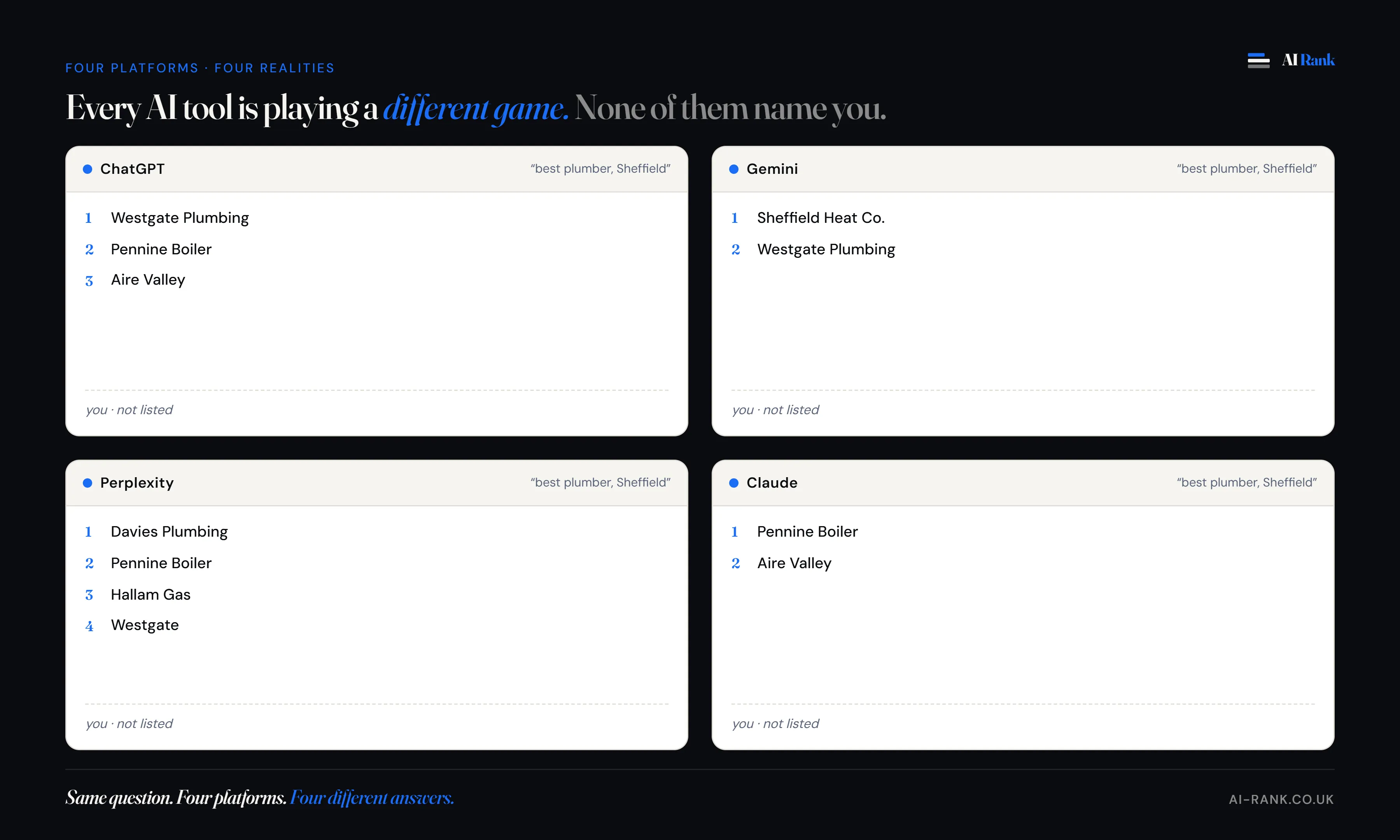
These platforms do not all behave the same way. ChatGPT can search the web in real time. Perplexity actively searches and cites its sources. Gemini draws on Google Maps data. Claude draws primarily on what it has absorbed from across the internet.
That means a business might appear on one platform and not another. In our testing through May 2026, we found that some platforms draw from a pool of businesses four times larger than others - even when asked the exact same questions about the same cities. The businesses they mention, how many they mention, and the reasons they give are meaningfully different across platforms. This is not one game with one set of rules. It is several games running at once.
What we see when we run the tests
We run AI recommendation tests across major platforms for local businesses in UK cities. We do not just record whether a business appears - we track what the AI actually says about the businesses it recommends.
After more than 4,800 tests, some patterns are clear. And they are not what most people expect.
The things that come up again and again when AI recommends a local business are not about having the best website, the most technical SEO, or the fanciest structured data. They are about being known, being specific, and being clearly local.
Businesses that AI mentions tend to be well established and visible across multiple independent sources online. They tend to describe what they do and where they do it in clear, specific language. They tend to have reviews on more than just one platform. And they tend to appear on directories and trade association sites that confirm what they claim.
Meanwhile, the things the industry talks about most - schema markup, structured data, site speed - barely come up in AI's reasoning at all. Google's own AI optimisation guide published in May 2026 confirmed that structured data is not required for AI search. Our testing independently reached the same conclusion: it almost never appears as a reason AI gives for recommending a business.
It is not about being better
This is the frustrating part. Your competitor might not do better work. They might have worse customer service, fewer years of experience, and lower-quality results. But if they are more visible across the places AI draws from, they get mentioned and you do not.
And this is not slowing down. Consumer use of AI for local business recommendations went from 6% to 45% in a single year, according to BrightLocal's 2026 survey. Every month the gap between businesses AI mentions and businesses it ignores gets harder to close.
Guessing will not fix this
You could read every article on the internet about AI visibility and start making changes based on general advice. Some of it might help. A lot of it will be wasted effort on things that do not actually move the needle.
The problem with guessing is that every business is different, every location is different, and every AI platform behaves differently. What works for a plumber in Leeds may not work for a solicitor in Birmingham. What gets you mentioned on Perplexity might have no effect on ChatGPT.
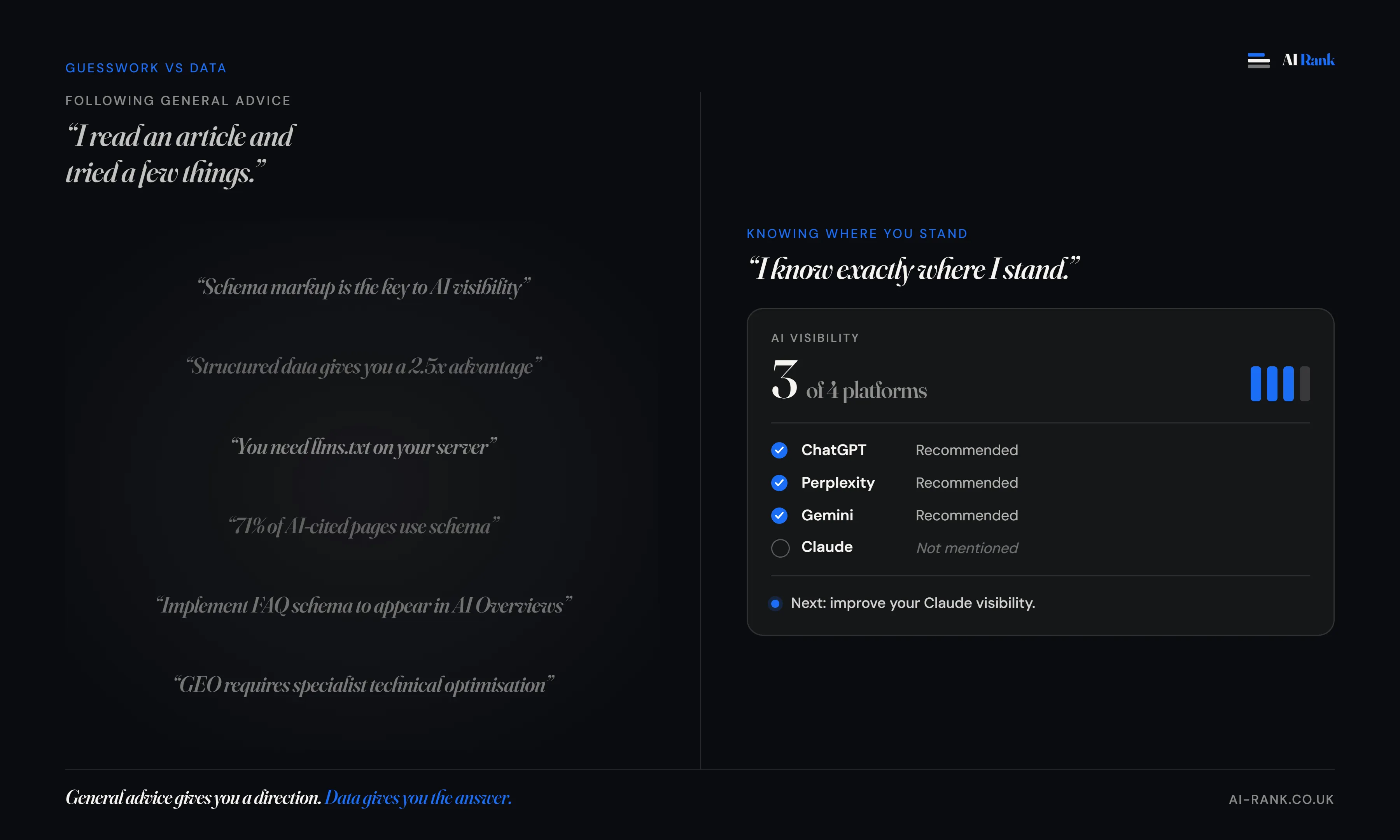
General advice gives you a general direction. It does not tell you where you specifically stand, which platforms mention your competitors instead of you, or what those competitors are doing differently.
That requires actual data. Real tests. Across real platforms. For your actual business.
That is what we built AI Rank to do
We do not guess. We test. We run your business through ChatGPT, Gemini, Perplexity, and Claude and show you exactly what comes back. Not assumptions. Not predictions. What the AI actually says when someone asks for a business like yours.
You can start with a free check right now. Your business name, your town. Thirty seconds.
Find out where you stand
See who AI recommends instead of you.
Check if AI recommends your business →If you want the full picture - where you appear, where your competitors appear instead, what the AI says about them that it does not say about you, and a prioritised action plan based on what the data actually shows - that is what our paid plans are for.
But the free check is where to start. Because until you have the data, everything else is guesswork.
Check if AI recommends your business
Run a free check to see whether AI can find your business, who it recommends instead, and what to improve first.
Check if AI recommends your businessSources
SOCi, 2026 Local Visibility Index (350,000+ locations, 2,751 brands) - 1.2% of locations recommended by ChatGPT; 11% by Gemini; 7.4% by Perplexity; 35.9% in Google's local 3-pack
BrightLocal, 2026 Local Consumer Review Survey (1,002 consumers) - AI usage for local recommendations grew from 6% to 45% in 12 months; AI is now the 3rd most popular discovery channel
AI Rank, May 2026 - 4,800 AI recommendation tests across four major platforms for UK local businesses; independently confirms SOCi's selectivity findings and Google's guidance on structured data
Google, Optimising for generative AI features on Google Search, May 2026 - structured data is not required for AI search; no special schema needed; AEO and GEO are still SEO